
Coffee with the Preacher

The Mystery of Suffering

2020 to 2021 has been upsetting for me. I have witnessed the suffering and death of love ones from Covid and other forms of sickness and disease.

Some got sick and got well, some got sick and the side affects linger, while others got sick and died.  

The Mystery of Suffering

Job 2:10

Job replied, You talk like a godless woman. Should we accept only good things from the hand of God and never anything bad?” So in all this, Job said nothing wrong.

There is nothing left for Job but to lament.

Photo by Alex Green on Pexels.com

He refuses to lay the blame on himself falsely, and he refuses to blame or abandon God.

But he does not hesitate to express his anguish in the strongest terms.

Let the day perish in which I was born, and the night that said, ‘A man-child is conceived’” (Job 3:3).

Why did I not die at birth, come forth from the womb and expire?” (Job 3:11).

“Or why was I not buried like a stillborn child, like an infant that never sees the light?” (Job 3:16).

Why is light given to one who cannot see the way, whom God has fenced in?” (Job 3:23).

Notice that Job’s lament is almost entirely in the form of questions.

THE CAUSE OF HIS SUFFERING IS A MYSTERY.

INDEED, IT MAY BE THE GREATEST MYSTERY OF FAITH.

Why does God allow people he loves to suffer?

Job does not know the answer, so the most honest thing he can do is ask questions.

Regrettably, Job’s friends are not able to endure the mystery of his suffering, so they jump to conclusions about its source.

The first of the three, Eliphaz, acknowledges that Job has been a source of strength to others (Job 4:3-4).

But then he turns and puts the blame for Job’s suffering squarely on Job himself.

“Think now,” he says, “who that was innocent ever perished? Or where were the upright cut off?

As I have seen, those who plow iniquity and sow trouble reap the same” (Job 4:7-8).

Job’s second friend, Bildad, says much the same.

See, God will not reject a blameless person nor take the hand of evildoers” (Job 8:20). (Miss judging God.)

The third friend, Zophar, repeats the refrain.

“If iniquity is in your hand, put it far away, do not let wickedness reside in your tents.

Surely then you will lift up your face without blemish; you will be secure, and will not fear.…Your life will be brighter than the noonday” (Job 11:14-1517).

Their reasoning is a form of logic.

God sends calamities upon wicked people only.

  1. You have suffered a calamity.
  2. Therefore, you must be wicked.
  3. Job himself avoids this false logic.
  4. But it is very commonly accepted by Christians.

It is called a theology of divine retribution, and it assumes that God blesses those who are faithful to him and punishes those who sin.

It is not entirely without biblical support.

There are many cases in which God sends calamity as a punishment, as for example he did at Sodom (Genesis 19:1-29).

Often, our experiences do bear out this theological position.

In most situations, things turn out better when we follow God’s ways than when we forsake them.

However, God does not always work that way.

Jesus himself pointed out that disaster is not necessarily a sign of God’s judgment (Luke 13:4).{When he addressed the 18 who died at the tower being the most wick?)

In Job’s case, we know the theology of divine retribution is not true because God says that Job is a righteous man (Job 1:82:3).

Job’s friends’ disturbing error is to apply a generalization to Job’s situation, without knowing what they’re talking about.

Anyone who has spent time with a suffering friend knows how hard it is to remain present without trying to give answers or make sense out of the situation.

It is excruciating to suffer silently with a friend who must rebuild life piece by piece, without any certainty about the outcome.

Our instinct is to investigate what went wrong and identify a solution.

Then we imagine we can help our friend eliminate the cause and get back to normal as soon as possible.

Knowing the cause, we will at least know how to avoid the same fate ourselves.

We would rather give a reason for the suffering — be it right, be it wrong — than to accept the mystery at the heart of suffering.

Job’s friends succumb to this temptation.

It would be foolish to imagine that we would never do the same.

How much harm have well-intentioned Christians caused by giving pious-sounding answers to suffering, even though we have no idea what we’re talking about?

 “It’s all for the best.”

 “It’s part of God’s plan.”

“God never sends people more adversity than they can handle.”

How arrogant to imagine we know God’s plan.

How foolish to think we know the reason for anyone else’s suffering.

We don’t even know the reason for our own suffering.

 It would be more truthful — and far more helpful — to admit, “I don’t know why this happened to you. No one should have to go through this.”

 If we can do this, and then remain present, we may become an agent of God’s compassion.

Job’s friends can’t lament with Job or even acknowledge that they lack a basis for judging him.

They are hell-bent (literally, given Satan’s role) on defending God by placing the blame on Job.

As the friends’ speeches continue, their rhetoric becomes increasingly hostile.

Faced with the self-imposed choice of blaming Job or blaming God, they harden their hearts against their former friend. “There is no end to your iniquities,” says Eliphaz (Job 22:5), and then he invents some iniquities to charge against Job.

“You have given no water to the weary to drink, and you have withheld bread from the hungry” (Job 22:8).

 “You have sent widows away empty-handed, and the arms of the orphans you have crushed” (Job 22:9).

Zophar’s last speech observes that wicked persons will not enjoy their riches because God will make their stomachs “vomit them up again” (Job 20:15) and that “They will give back the fruit of their toil, and will not swallow it down; from the profit from their trading they will get no fruit of their enjoyment” (Job 20:18).

This is an appropriate righting of the wicked’s wrongdoing, that “they have crushed and abandoned the poor,  they have seized a house that they did not build” (Job 20:19). The reader knows this does not apply to Job. Why is Zophar so eager to blame Job?

Are we sometimes too eager to follow in Zophar’s footsteps when our friends face failures in work and life?

The book of Job demands that we see ourselves in the faces of Job’s friends. We too — presumably — know right from wrong, and have some sense of God’s ways.

But we do not know all of God’s ways as they apply in all times and places.

 “Such knowledge is too wonderful for me; it is so high that I cannot attain it” (Psalm 139:6).

God’s ways are often a mystery beyond our understanding.

Is it possible that we also are guilty of ignorant judgments against our friends and co-workers?

But it doesn’t have to be friends who accuse us. Unlike Job, most of us are quite ready to accuse ourselves.

Anyone who has tasted failure has likely pondered, “What have I done to deserve this?” It’s natural, and not altogether incorrect.

Sometimes out of sheer laziness, bad data or incompetence, we make poor decisions that cause us to fail at work.

However, not all failures are the direct result of our own shortcomings.

Many are the result of circumstances outside our control.

Workplaces are complex, with many factors competing for our attention, many ambiguous situations, and many decisions where the outcomes are impossible to predict. How do we know whether we are following God’s ways all the time?

How could we or anyone genuinely know whether our successes and failures are due to our own actions or to factors beyond our control?

How could an outsider judge the rightness of our actions without knowing the intimate details of our situations?

Indeed, how could we even judge ourselves, give the limits of our own knowledge?

Coffee with the Preacher

Has Faith Been Hijacked?

Study Guide on Faith and Temptation

Introduction

In this study, we explore the theme of faith in God and the various influences that seek to hijack it. We will examine scriptural references and related teachings to understand the importance of guarding our faith.

Key Themes

1. The Danger of Hijacking Faith

  • The scriptures warn of false teachers attempting to hijack the faith of believers (Galatians 5:19-21).
  • Key Question: Why do people seek to hijack our faith?

2. The Contrast Between Grace and Law

GraceLaw
Based on faith (2:16)Based on works (2:16)
Justifies sinful men (2:16, 17)Incapable of justification (2:16; 3:11)
Begins and ends with Christ (2:20)Makes Christ nothing (5:3)
Results in intimacy with Christ (3:27)Results in estrangement from Christ (5:4)

3. The Inner Conflict

  • Galatians 5:17 (KJV 1900) discusses the struggle between the flesh and the Spirit.
  • Understanding this conflict is crucial for maintaining our faith.

4. Temptations in the Digital Age

  • The prevalence of technology brings new temptations, similar to the thief described in John 10:10.
  • Awareness of these temptations is essential to preserving our identity and faith.

Key Scriptures

  • Galatians 5:19–21 (NLT): Discusses the results of following the desires of the sinful nature.
  • Romans 3:23 (KJV): “For all have sinned, and come short of the glory of God.”
  • Acts 16:30-31 (KJV): Encourages belief in Jesus for salvation.

Personal Reflection Questions

  1. How can we actively guard against the hijacking of our faith?
  2. In what ways does understanding grace versus law impact our relationship with God?
  3. How do modern temptations challenge our faith, and what strategies can we employ to resist them?

Discussion Questions

  1. Have you ever encountered a situation where your faith felt challenged? What helped you navigate that experience?
  2. How can the church community support individuals in recognizing and resisting temptations that can hinder their faith?
  3. What role does personal accountability play in maintaining one’s faith in the face of temptation?
  4. How can we best educate younger generations about the differences between grace and law?
  5. In what ways can technology be used positively to strengthen our faith and community?

Conclusion

This study guide serves as a reminder of the importance of faith and vigilance against influences that may seek to hijack our belief in God. Through understanding scripture and personal reflection, we can strengthen our commitment to God’s grace and truth.

Additional Resources

  • Paul S. Morton’s Song: “I’m Still Standing” – A reminder of resilience in faith.
  • Recommended readings on grace and the importance of a strong spiritual foundation.
Coffee with the Preacher

Coffee Time January 16th

Panelist: Dr. Benjamin Hinton, Dr. Rodney Freeman, Elder Billy Houze, and Pastor Robert Coleman

Discussion Questions

The questions are not political questions for they are directed toward church life and leadership in the present and future church.

“Words have power then how leadership frames their words matter because they will direct actions.”

  1. Under the present conditions of covid, political polarization, the economic, and anxieties what type of leader will be needed to guide believers through these unchartered waters?

A. Chaplain/Caregiver/Shepherd

B. Apostolic Apostle – Trail blazer

2.      Can the type of leaders who guided the church to the present be as effective going forward?

3.      God’s word is truth and truth is under attack, how do we convince believers that what we preach has eternal implications?

4.      With many worshipers not attending a building for nearly a year how will leadership get them back into a traditional church environment? Or more importantly get them to engage in the five functions of the church.

The new norm of church will possible have a larger online presence that in the building?

How will the pastors seek to lead this type of church?

  1. Worship
  2. Fellowship
  3. Discipleship
  4. Evangelism
  5. Ministry

How do you see church mission as it relate to vision now laid out before the body?

People without a vision….

Is your present vision in need of a revamping?

  • Rewind the vision
  • Rethink the vision
  • Reset the vision for the present age

In what ways will your church be different in 2021 from 2020?

Are churches in a hold pattern waiting to reopen the building or has church already changed?

Have you covid proofed your church for Wedding – Baptisms – Funerals – New Members Classes –

If your church doesn’t make it back after Covid would it be missed?

What ways have you seen Virtual and Online Church have a positive effect your local congregation in reaching, teaching, and maturing the membership?

What ways have you seen Virtual and Online Church have a negative effect on the local congregation?

If Online and Virtual Church has a 12 month shelf life will it……?

1.    Effect how we build church relationships and communicate

2.    Effect how we create ministries, ministry strategies and seek new people to join them {Will the sound and audio tech be as important as the organist and drummer}

3.    How we locate, invite and engage new searchers

4.    How we allocate the budget

5.    How we give people a reason to connect and communicate to others in the body

6.    How will we build singles, marriages, seniors, adults, and children ministries

7.    How do we meet the needs: Grief – Loneliness – corporate worship atmosphere – place of belonging – and families

8.    Gift discovery and Gift development

9.    Will the type of auxiliaries change from the traditional to meet needs in the future

Have you seen a need to restructure your mission given?

Have you seen a need to change your budget to meet technology development?

Have you seen a need to train and equip yourself, staff and deacons to help the membership with: Stress – Grief – depression – job lost – death – post covid church changes

Do you think the membership is prepared for few people returning to the church building due to death and drifting away of members?

Coffee with the Preacher

Good Representative of Christ

Colossians 3:17

Whatever you do or say, let it be as a representative of the Lord Jesus, all

the while giving thanks through him to God the Father.

Everything the believers said and everything they did should be done in the name of the Lord Jesus, realizing his constant presence and bringing honor and glory to him in every aspect and activity of daily living.

“So whether you eat or drink or whatever you do, do it all for the glory of God” (1 Corinthians 10:31 niv).

To act in someone’s name is to act on his authority; believers act as Christ’s representatives.

Paul echoed the need for a thankful spirit, as he had in 3:15 and 3:16.

All we do for Christ should be done with the spirit of thankfulness for all he has done for us.

Believers are not enslaved to rules about every word they speak or deed they do; instead, they freely put themselves under the Lord’s guidance because they love him, have accepted his salvation, and live to glorify him.

Their thanks can go to God through Christ because Christ is the only mediator between God and people.

Believers are marked by Christlike living.

Paul offers a strategy to help us live for God day by day: {Everyday Praise}

  • Imitate [Follow as a pattern] Christ’s merciful, forgiving attitude (3:12–13);

Colossians 3:12-13 (NLT2)
12  Since God chose you to be the holy people he loves, you must clothe yourselves with tenderhearted mercy, kindness, humility, gentleness, and patience.
13  Make allowance [Patient and Restrain] for each other’s faults, and forgive anyone who offends you. Remember, the Lord forgave you, so you must forgive others.

  • Let love guide your life (3:14);

Colossians 3:14 (NLT2)
14  Above all, clothe yourselves with love, which binds us all together in perfect harmony.

{1 Peter 4:8} (NLT2)
8  Most important of all, continue to show deep love for each other, for love covers a multitude of sins
.

  • Let the peace of Christ rule in your heart (3:15);

Colossians 3:15 (NLT2)
15  And let the peace that comes from Christ rule in your hearts. For as members of one body you are called to live in peace. And always be thankful.

  • Always be thankful (3:15);

Colossians 3:15 (NLT2)
15  And let the peace that comes from Christ rule in your hearts. For as members of one body you are called to live in peace. And always be thankful.

  • Keep God’s Word in you at all times (3:16);

Colossians 3:16 (NLT2)
16  Let the message about Christ, in all its richness, fill your lives. Teach and counsel each other with all the wisdom he gives. Sing psalms and hymns and spiritual songs to God with thankful hearts.

  • Live as Jesus Christ’s representative (3:17).

Colossians 3:17 (NLT2)
17  And whatever you do or say, do it as a representative of the Lord Jesus, giving thanks through him to God the Father.

Doing everything “as a representative of the Lord Jesus” means bringing honor to Christ in every aspect and activity of daily living.

As a Christian, you representChrist at all timeswherever you go and whatever you say.

What impression do people have of Christ when they see or talk with you?

What changes would you make for your life to honor Christ?

Believers are marked by the way they treat each other.

Christians should live in peace.

This does not eliminate all differences in opinion, but loving Christians will work together despite their differences.

Such love is not a feeling, but a decision to meet others’ needs (see 1 Corinthians 13).

This commitment to others leads to peace between individuals and among the members of the body of believers.

Do problems in your relationships with other Christians cause open conflicts or mutual silence?

Consider what you can do to heal those relationships with love.

The word rule (3:15) comes from athletics: Paul tells us to let Christ’s peace be umpire or referee in our hearts.

Our heart is the center of conflict because there our feelings and desires clash—our fears and hopes, distrust and trust, jealousy and love.

How can we deal with these constant conflicts and live as God wants?

Paul explains that we must decide between conflicting elements by using the rule of peace: Which choice will promote peace in our souls and in our churches?

For more on the peace of Christ, see Philippians 4:9.

Believers are marked by the way they treat outsiders.

The Christian church should have no barriers of nationality, race, education, social standing, wealth, gender, religion, or power.

Christ breaks down all barriers and accepts all people who come to him.

Nothing should keep us from telling others about Christ or accepting into our fellowship any and all believers (Ephesians 2:14–15).

Christians should be building bridges, not walls.

When the Lord returns “in His glory,” He will judge not only the nation Israel (as in the Parable of the 10 Virgins [vv. 1–13] and the Parable of the Talents [vv. 14–30]) but also the Gentiles.

Matthew 25:37–46 (NLT)

37 “Then these righteous ones will reply, ‘Lord, when did we ever see you hungry and feed you? Or thirsty and give you something to drink? 38 Or a stranger and show you hospitality? Or naked and give you clothing? 39 When did we ever see you sick or in prison and visit you?’

40 “And the King will say, ‘I tell you the truth, when you did it to one of the least of these my brothers and sisters, you were doing it to me!’

41 “Then the King will turn to those on the left and say, ‘Away with you, you cursed ones, into the eternal fire prepared for the devil and his demons. 42 For I was hungry, and you didn’t feed me. I was thirsty, and you didn’t give me a drink. 43 I was a stranger, and you didn’t invite me into your home. I was naked, and you didn’t give me clothing. I was sick and in prison, and you didn’t visit me.’

44 “Then they will reply, ‘Lord, when did we ever see you hungry or thirsty or a stranger or naked or sick or in prison, and not help you?’

45 “And he will answer, ‘I tell you the truth, when you refused to help the least of these my brothers and sisters, you were refusing to help me.’

46 “And they will go away into eternal punishment, but the righteous will go into eternal life.”

Coffee with the Preacher

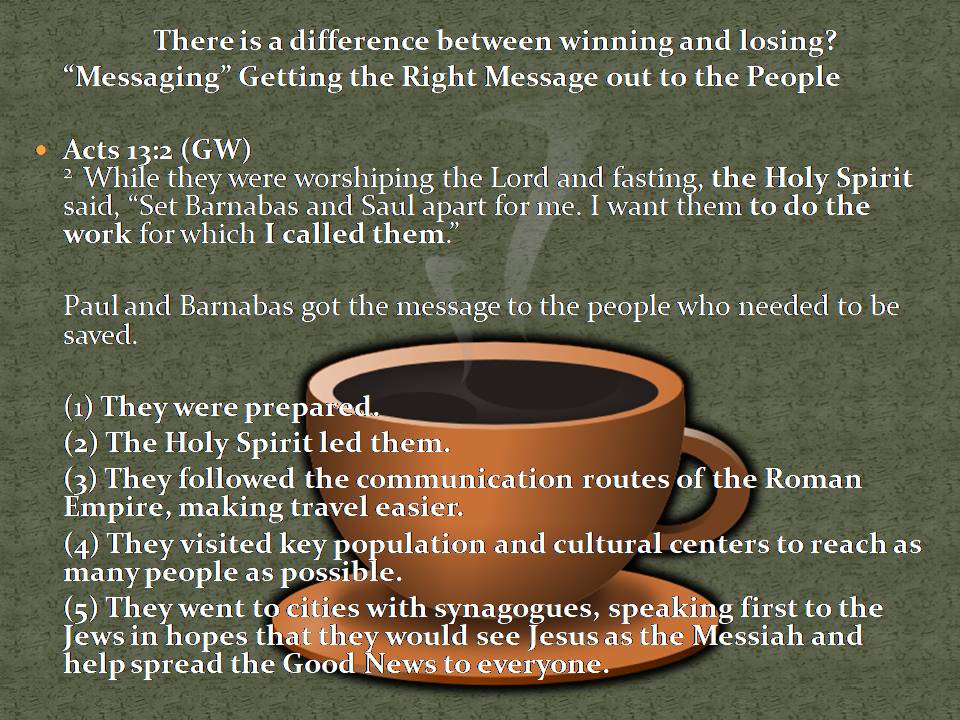
Are we getting a relatable and relevant message about Christ to the people?

I am writing this because after elections people examine cause and effect or what worked and what failed.

Interestingly it comes down to getting the voters out but to get people to the polls means have a message that they can relate to.

Having the right message and the right time came be the different between declared the winner or going home.

It is more critical today that the church get the message out to the world that God is still God!

There were 4 writers who pen and presented the gospel to the world in the New Testament. The 4 writers were Matthew, Mark, Luke, and John.

The book of Acts was written by Luke tells of the coming of the Holy Spirit, the Holy Spirit in the life of the apostles, and the establishment of the church.

There are discussions about the 21 or 22 letters to the church due to the fact that Revelation was written in a different style.

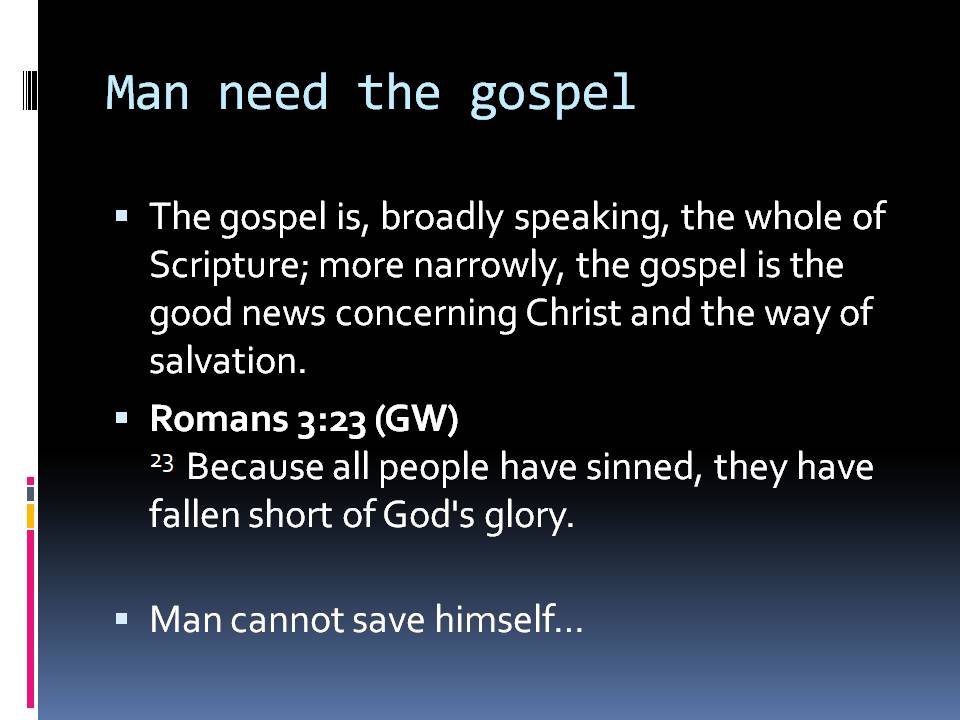
The bible Old Testament and New Testament is about messaging. It was and is imperative that people understand the Gospel to believe the Gospel.

  1. The gospel is a message about God.
  2. The gospel is a message about sin and the consequences.
  3. The gospel is a message about Christ—Christ, the Son of God incarnate; Christ, the Lamb of God, dying for sin; Christ, the risen Lord; Christ, the perfect Savior.
  4. We must not present the Person of Christ apart from His saving work.
  5. But there is a second and complementary point: we must not present the saving work of Christ apart from His Person.
  6. The gospel is a summons to faith and repentance.
  7. The demand is for faith as well as repentance. 
  8. The demand is for repentance as well as faith